
The expansion of Canberra Hospital in Garran, Australia, is a significant project designed to meet the growing healthcare needs of the region. As part of this new development, the hospital features a modern building that stands out not only for its medical capabilities but also for its innovative architecture.
The building’s facade is a central element of its design. It serves as a large-scale work of art, provides sustainable cooling, and ensures safety through reliable fall protection. To achieve this combination of aesthetics and performance, the project utilizes X-TEND® CXA Stainless Steel Cable Mesh, demonstrating how advanced architectural materials can transform a functional hospital building into a cultural and environmental landmark.
A Facade That Tells a Story
Hospitals are often designed with strict functionality in mind, but the new building at Canberra Hospital takes a different approach. The facade integrates a stunning piece of art titled “Journey to Healing,” created by the talented First Nations artist Lynnice Church.
This artwork is brought to life using 25,000 sequins attached directly to the Stainless Steel Cable Mesh. The mesh acts as a flexible, transparent canvas, allowing the sequins to form an impressive pattern that covers the exterior of the building. As the light changes throughout the day, the sequins create a dynamic, fascinating installation that reflects the cultural significance of the artwork and the healing mission of the hospital.
By incorporating First Nations art into the building envelope, the hospital creates a welcoming and culturally rich environment for patients, staff, and visitors.
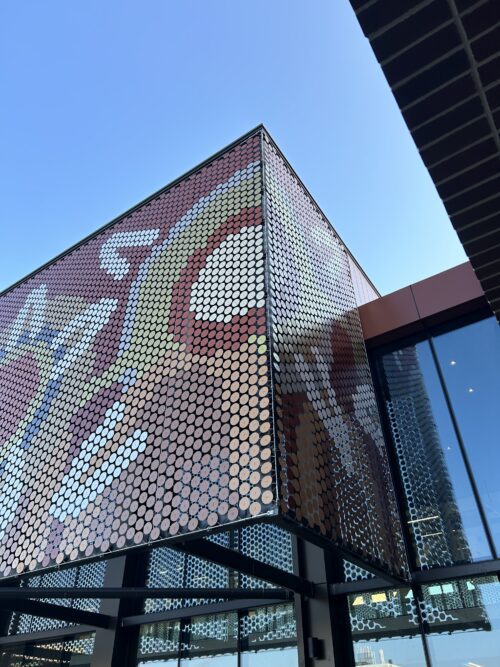
Stainless Steel Cable Mesh for Design and Fall Protection
The foundation of this artistic facade is X-TEND® CXA Stainless Steel Cable Mesh by Carl Stahl Architecture. The project uses approximately 399 square meters of mesh, with a mesh size of 140 mm and a cable diameter of 3.0 mm.
This specific configuration provides the strength needed for fall protection while maintaining the visual lightness required for the art installation. The mesh must support the weight and movement of the 25,000 sequins, resist wind loads, and ensure the safety of the building’s occupants.
Key benefits of using Stainless Steel Cable Mesh in this application include:
- High tensile strength for reliable fall protection
- Visual transparency that allows the artwork to stand out
- Durability in outdoor environments
- Flexibility to adapt to the building’s architectural form
- Low maintenance requirements over the building’s lifespan
The mesh provides a secure, long-lasting structure that performs its technical duties quietly, letting the artistic elements take center stage.
Sustainable Cooling Through Innovative Facade Design
Beyond its artistic and safety functions, the facade at Canberra Hospital also contributes to the building’s environmental performance. The combination of the Stainless Steel Cable Mesh and the attached sequins acts as a shading system, helping to reduce solar heat gain.
In Australia’s climate, managing heat buildup is a critical part of sustainable building design. By shading the exterior, the facade helps lower the cooling load on the hospital’s HVAC systems. This sustainable cooling approach improves energy efficiency, reduces operational costs, and creates a more comfortable indoor environment for patients and staff.
This dual-purpose design—where art also serves as climate control—highlights the versatility of Stainless Steel Cable Mesh systems. They can be used not just as structural barriers, but as active components in a building’s energy strategy.
Collaboration and Architectural Innovation
The successful realization of the Canberra Hospital facade required close collaboration and innovative engineering. The project was designed by BVN Architecture and brought to life through a partnership with Ronstan Tensile Architecture, specialists in tensile structures.
Working with Stainless Steel Cable Mesh on this scale, especially when integrating thousands of individual sequins, demands precision. The mesh must be tensioned correctly to maintain its shape and structural integrity, while the attachments must be secure enough to withstand weather conditions without damaging the cables.
This collaborative effort showcases how architects, artists, and engineers can use advanced materials like X-TEND® CXA to push the boundaries of what a hospital facade can be.
The Role of Stainless Steel Cable Mesh in Modern Healthcare Architecture
Healthcare facilities are evolving. Modern hospitals aim to be more than just clinical spaces; they strive to be healing environments that promote well-being through natural light, connection to nature, and thoughtful design.
Stainless Steel Cable Mesh supports these goals in several ways:
- Safety without confinement: It provides necessary fall protection on balconies, staircases, and facades without creating dark, enclosed spaces.
- Support for greenery: It can be used to create green walls and healing gardens, bringing nature closer to patients.
- Customizable aesthetics: As seen at Canberra Hospital, it can support custom art installations and dynamic shading systems.
- Hygiene and durability: Stainless steel is easy to clean, resistant to corrosion, and long-lasting, making it ideal for healthcare settings.
By choosing Stainless Steel Cable Mesh, architects can design hospitals that are safe, efficient, and visually inspiring.
Shaping the Future of Canberra Hospital Design
The new building at Canberra Hospital is a powerful example of how architecture can integrate culture, sustainability, and safety. Through the use of X-TEND® CXA Stainless Steel Cable Mesh, the hospital features a facade that is both a reliable fall protection system and a canvas for the beautiful “Journey to Healing” artwork.
With its 25,000 sequins, the installation provides sustainable cooling while creating a visually stunning landmark in Garran. This project demonstrates the incredible versatility of Stainless Steel Cable Mesh, proving that technical building materials can also be instruments of art and environmental responsibility. As healthcare design continues to focus on holistic healing environments, solutions like this will play a key role in shaping the hospitals of the future.